
Summary
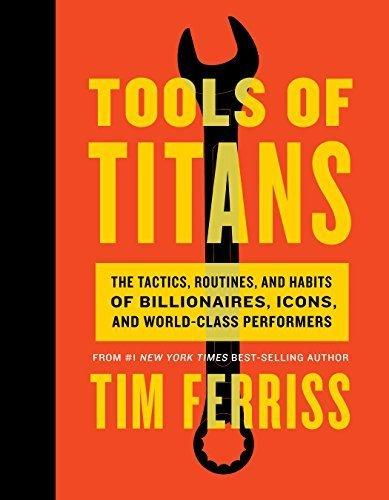
“Tools of Titans” by Tim Ferriss gathers lessons, habits, and routines from more than a hundred world-class performers. Ferriss distills their most potent tactics into three broad themes: health, wealth, and wisdom. Readers find a treasure trove of tips ranging from morning rituals to mind hacks, all offered in bite-size form with direct, actionable steps.
Ferriss opens with morning routines. He shows how elite athletes prime their bodies before dawn, whether through cold plunges, breathwork, or short strength circuits. He highlights how entrepreneurs like Kevin Rose journal first thing, capturing thoughts while still half asleep. Small habits, Ferriss argues, compound into profound gains over months and years.
In the health section, Ferriss drills into diet experiments. He recounts how guests test slow-carb menus, cyclical keto, or intermittent fasting to boost energy. He describes lab work and biomarker tracking that helped Dr. Peter Attia refine his own nutrition. The emphasis remains on self-experimentation: try, measure, adjust.
Exercise strategies fill another chunk. Ferriss offers simplified routines that mimic what Olympic athletes use but fit into twenty minutes. He details Pavel Tsatsouline’s kettlebell swings and Jim Wendler’s five-three-one protocol for strength. He stresses that consistency matters more than complexity.
Ferriss then pivots to wealth creation. He profiles founders who built companies on minimal viable products and rapid feedback loops. He shares Derek Sivers’s story of testing business ideas with a single web page before launching a full platform. Ferriss urges readers to validate assumptions cheaply.
He outlines high-leverage habits for productivity. He recommends the one-page business plan, time-blocking, and the 80/20 rule to find the critical few tasks that drive most results. He cites venture capitalist Chris Sacca’s practice of breaking days into thematic blocks and saying no to 99 percent of opportunities.
Negotiation tips follow. Ferriss quotes Chris Voss, former FBI negotiator, on tactical empathy and calibrated questions. He illustrates how pausing after a single word, “Really?” can prompt a counterpart to fill silence with valuable information. He shows how framing deals as “What about this is important to you?” opens doors.
The wisdom section steps back from tactics to mindset. Ferriss shares Stoic insights from Ryan Holiday on managing fear and desire. He narrates how reading Marcus Aurelius daily helped Holiday build resilience. He suggests writing down one phrase from a philosophical text each morning to internalize deep truths.
Mental models receive attention next. Ferriss explains inversion—thinking about how things can fail—to sharpen strategy. He gives examples from poker and venture capital, where participants consider worst-case scenarios first. That approach, he says, often reveals blind spots others overlook.
Creativity and learning get their own space. Ferriss recounts Tim Urban’s method of tackling huge problems by drawing flowcharts and mapping ideas visually. He outlines Josh Waitzkin’s technique of iterative practice—pushing just beyond comfort, then backing off to recover. The cycle, Ferriss reports, drives deep skill acquisition.
Ferriss also highlights the importance of rest. He reviews polyphasic sleep experiments, afternoon naps, and infrared sauna sessions shared by his guests. He shows that top performers schedule recovery with the same care they apply to work. Overtraining, Ferriss warns, erodes both body and mind.
In another chapter, Ferriss tackles fear and risk taking. He recounts how Derek Sivers jumped into public speaking with zero experience and got better by filming himself nightly. He explains Ferriss’s own practice of “fear-setting,” a written exercise mapping worst-case outcomes and recovery plans.
Throughout the book, Ferriss peppers anecdotes. He notes how Brandon Burchard carried a rubber duck to remind himself to lighten up. He recalls how Maria Popova balanced blogging with parenting by batching all writing into two hours each morning. These small stories keep the advice relatable.
Ferriss ends each section with “After Action Reports” summarizing key tools, books, and routines. He lists meditation apps like Headspace, favorite supplements, podcasts worth subscribing to, and business books to devour. The lists distill hundreds of pages into one-page cheat sheets.
Ultimately, “Tools of Titans” reads like an intensive workshop spread across three hundred pages. Ferriss invites readers to pick a few tactics, test them for thirty days, and keep what sticks. He reminds us that small, consistent improvements—compounded over time—lead to outsized results. The book’s final message encourages curiosity, bold experimentation, and relentless self-measurement.
Detailed Summary
Key Takeaways
1. Embrace the Minimal Effective Dose
“The minimum effective dose is the smallest dose that will produce the desired outcome and anything beyond that is waste.”
Essential Efficiency: Tim Ferriss highlights the principle of the Minimal Effective Dose (MED) as a guiding strategy across health, productivity, and learning. By focusing on the smallest actionable step that yields the greatest result, you avoid wasted effort and accelerate progress. Ferriss draws on interviews with elite performers who distill complex practices into their simplest, most powerful components.
He shows that applying MED means cutting away excess. Instead of a long, drawn-out workout plan, you identify the key movements that drive strength gains. Rather than a massive reading list, you pinpoint the two or three books that deliver the core frameworks you need. This principle encourages constant prioritization and ruthless elimination of nonessentials.
Streamlining Success: Adopting MED reshapes daily habits and long-term goals. In business, it lets founders focus on the 20% of features that deliver 80% of user value. In health, it reduces injury risk and burnout by avoiding overtraining. The clarity that comes from stripping tasks to their core fosters consistency. It also frees time and mental energy for deep work or creative pursuits.
Historically, thinkers from Leonardo da Vinci to modern executives have practiced this idea intuitively. Ferriss brings it to light explicitly, empowering anyone to challenge conventional “more is better” dogmas. The result is a culture shift toward lean experimentation and rapid feedback loops, where small wins accumulate into large breakthroughs.
Key points:
- Prioritize the smallest change that produces big results
- Eliminate non-essential steps or habits
- Apply across health, business, and learning
- Use rapid feedback to adjust and refine
- Prevent burnout through focused effort
2. Design Your Morning Routine
“People will conform to the model you present to them for what is ‘normal.’”
Habit Architecture: Ferriss argues that you can engineer your ideal life by first designing your ideal morning. He profiles high achievers who use simple rituals—meditation, journaling, cold exposure—to boost mood, clarity, and energy. By deliberately selecting activities that prime focus and creativity, you set a positive trajectory for the rest of the day.
Rather than letting external demands hijack your priorities, this approach grants you early self-sovereignty. By controlling the first hour, you establish boundaries and momentum. Ferriss shows that even five minutes of deep breathing can anchor your state when chaos ensues later.
Foundation for Productivity: A carefully crafted morning practice leads to tangible gains. Entrepreneurs report fewer distractions and stronger decision-making. Athletes experience more consistent performance. Students develop better concentration. When repeated daily, these routines become automatic triggers that steer behavior toward goals.
On a societal level, promoting intentional starts challenges the myth of glorified busyness. It invites organizations and schools to rethink schedules, valuing mental readiness over arbitrary checklists. Ferriss’s interviews underscore how routine design can reshape personal and institutional cultures.
Key points:
- Choose rituals that boost energy and focus
- Start with as little as five minutes
- Use meditation, movement, cold showers, or journaling
- Automate cues to trigger desired habits
- Adjust over time based on feedback
3. Leverage Fear as a Compass
“What we fear doing most is usually what we most need to do.”
Fear-Guided Growth: Ferriss introduces “fear-setting,” a framework to confront and dissect fears that hold you back. By writing down worst-case scenarios, preventive steps, and potential for recovery, you demystify risks. This process often reveals that the cost of inaction outweighs the cost of action.
Interviewees such as Navy SEAL Jocko Willink use similar tactics to enter high-pressure situations prepared. By normalizing discomfort, they expand their comfort zone. Ferriss emphasizes that repeated exposure to small fears builds resilience for larger challenges.
Cultivating Courage: Using fear-setting dismantles analysis paralysis in startups, career shifts, or creative projects. Entrepreneurs launch products earlier. Job seekers negotiate boldly. Artists share work despite self-doubt. As more people practice this, communities emerge that value vulnerability and calculated risk.
Historically, pioneers in science and exploration employed parallel strategies. Ferriss revives these time-tested methods for modern life. The ripple effect extends beyond individuals: workplaces that encourage confronting fears innovate faster and handle crises with greater agility.
Key points:
- Define your fears in writing
- Outline preventative actions
- Assess recovery plans if worst case occurs
- Take micro-risks to expand your tolerance
- Build resilience through repeated practice
4. Cultivate Selective Learning
“What’s the one skill that will give you 80% of the benefits of the entire field?”
Focused Skill Acquisition: Ferriss profiles guests who master fields swiftly by identifying the most impactful subskills. Instead of trying to learn everything, they narrow in on the core that delivers disproportionate advantage. For language learners, this may involve memorizing 100 high-frequency words. For negotiators, it could be mastering a few framing techniques.
This approach uses the Pareto principle to guide learning. Ferriss shows that systematic deconstruction of a domain reveals the high-leverage elements. You then practice these with deliberate repetition until proficiency arises.
Accelerated Expertise: Selective learning transforms how professionals upskill. Managers pick critical communication frameworks. Programmers learn key algorithms before frameworks. Musicians focus on foundational scales. As organizations adopt this mindset, training budgets stretch further and employees adapt more rapidly to changing demands.
On a societal scale, emphasizing high-impact learning can democratize expertise. People in resource-limited settings gain skills that deliver real benefits quickly. Ferriss’s interviews highlight success stories that inspire educational reform toward outcome-driven curricula.
Key points:
- Identify the 20% of skills yielding 80% of results
- Deconstruct domains into core elements
- Practice deliberately and measure progress
- Ignore low-impact peripheral skills
- Adjust focus based on evolving goals
5. Optimize Recovery and Rest
“If you’re constantly grinding, you miss half the life you could be living.”
Strategic Downtime: Ferriss underscores the importance of rest as an integral performance tool rather than an afterthought. He explores methods like contrast therapy, float tanks, and structured naps to enhance recovery. Guests such as Dr. Peter Attia emphasize that optimizing sleep quality and active recovery accelerates gains in strength, cognition, and emotional resilience.
By planning recovery phases with the same care as work phases, you avoid burnout and maintain long-term productivity. Ferriss shows that rest isn’t laziness but a vital input for sustainable success.
Sustainable High Performance: Individuals who prioritize recovery report fewer injuries and improved mental health. Leaders avoid decision fatigue. Creative professionals experience more consistent inspiration. As this idea spreads, corporate wellness programs adopt scientifically backed rest protocols, and healthcare systems recognize preventive rest as cost-effective medicine.
Culturally, embracing recovery challenges the work-aholic narrative. Ferriss’s research fosters a shift where rest is seen as strength rather than weakness. It encourages policymakers to consider rest-friendly labor laws and incentivize balanced lifestyles.
Key points:
- Schedule sleep and naps strategically
- Use contrast therapy and float tanks
- Treat rest as a performance input
- Monitor recovery via heart-rate variability or tracking
- Balance work phases with deliberate downtime
6. Build a Compounding Network
“Your network is your net worth.”
Relational Leverage: Tim Ferriss compiles tactics for forging high-value relationships in any field. He profiles connectors who practice generous outreach, offer help without expectation, and maintain contact through small gestures. By focusing on authenticity and providing value first, they cultivate networks that compound over time.
Ferriss highlights the role of “warm introductions” and strategic mentorship. Guests like Reid Hoffman demonstrate how intentional networking can accelerate career growth and open doors that simple cold outreach cannot.
Exponential Opportunities: A well-nurtured network brings more than job leads. It yields partnerships, new ideas, and emotional support. Startups find cofounders. Writers find editors. Nonprofits find donors. When more people adopt generous networking, industries become more collaborative and innovative.
Historically, salons and guilds served similar functions. Ferriss repackages these age-old practices for the digital era. The result is a cultural shift toward reciprocal generosity and shared success across sectors.
Key points:
- Offer help first without expecting return
- Use warm introductions to connect people
- Maintain relationships through small gestures
- Seek mentors and peer champions
- Leverage digital tools for scalable outreach
Future Outlook
Ferriss’s synthesis of titan-level tactics offers a blueprint for personal and professional evolution. As readers integrate these practices, they not only transform individual lives but also ripple these efficiencies into teams, organizations, and communities. Expect continued research on optimizing human performance to converge across disciplines—blending neuroscience, data analytics, and time-tested wisdom.
In the years ahead, education and corporate training will likely adopt modular, high-leverage frameworks inspired by Ferriss’s MED and focused learning principles. We’ll see AI tools that suggest personalized minimum effective routines and recovery protocols. Moreover, a culture that values deliberate rest and fear-setting may reshape mental health approaches and labor policies worldwide.
Ultimately, Tools of Titans will remain a touchstone for those who seek deliberate design in their lives. Its ideas will spawn new experiments in routine architecture, risk management, and network building. As each generation adds its own refinements, the titan toolbox will expand, reinforcing the ethos that success springs from small, intentional choices made daily.







