Summary
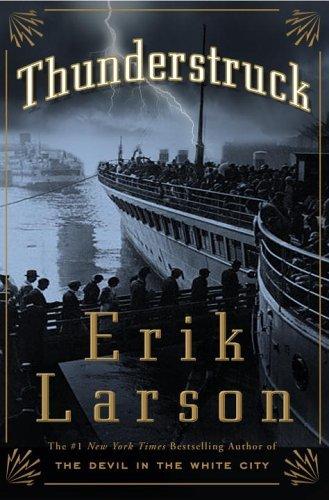
Thunderstruck by Erik Larson weaves together the story of Guglielmo Marconi’s pioneering work in wireless telegraphy and the sensational murder case of Dr. Hawley Crippen. Set in the early 1900s, the book shows how two seemingly unrelated threads—one scientific and one criminal—converged to reshape modern communication and law enforcement. Larson moves back and forth between Marconi’s laboratories and Crippen’s trial, highlighting how a flicker of radio waves helped catch a fugitive half a world away. Through rich detail and brisk pacing, Thunderstruck reveals the human drama behind groundbreaking technology and a headline-grabbing crime.
At the turn of the century, London hummed with excitement over new inventions. Electric lights replaced gaslamps, and factories buzzed with machines. Marconi, an Italian inventor, saw an even bolder frontier: transmitting messages through the air. He believed that wires would one day become obsolete. His vision sounded like magic to many.
Marconi grew up fascinated by electricity and sparks. As a boy, he spent hours tinkering in his father’s study, drawing diagrams and connecting batteries. He read widely and wrote letters to prominent scientists asking questions. By his early twenties, he built his first crude wireless machine in his family’s attic. It worked for only a few hundred feet—but it worked.
Undeterred by skeptics, Marconi set out to prove that signals could travel much farther. He erected a tall mast in a field outside Bologna and sent a simple letter “S” across 2 miles. Reporters came, curious to see dots and dashes appear out of thin air. Marconi beamed his success back to London, where newspapers proclaimed a new era had dawned. Investors began to take notice.
Next came the challenge of water. Marconi shipped his apparatus aboard a boat in the Bristol Channel. He tapped out messages that reached shore stations miles away. Waves rolled beneath his feet while radio pulses soared overhead. That test clinched his reputation—ships could now talk to land without cables. Sea travel would never be the same.
Marconi moved on to grander demonstrations. In 1899, he strung up aerials between England and France and sent the first wireless signal across the English Channel. Audiences gasped when the Morse code arrived exactly on schedule. Naval officials realized they could track warships and protect convoys. Governments scrambled to secure rights to Marconi’s patents.
By 1901 Marconi aimed even higher. He built giant towers on opposite sides of the Atlantic—one in Cornwall, the other in Newfoundland. On December 12, a faint but clear “S” drifted across 2,200 miles of ocean. The achievement stunned the scientific world. Radio waves had conquered the globe.
Meanwhile in London, Dr. Hawley Crippen, an American homeopathic physician, lived with his wife Cora. Their marriage grew cold and secretive. Neighbors noted odd sounds and strange smells coming from their home in Hilldrop Crescent. Rumors swirled but no one suspected murder. Then Cora vanished without a trace.
Police grew suspicious after Crippen claimed his wife had returned to the United States. He stayed behind with his secretary, Ethel Le Neve. Detectives searched the basement of Crippen’s house and found disturbing evidence—bloodstains and chopped flesh. Panic gripped the neighborhood as headlines screamed foul play.
Crippen panicked and boarded the SS Montrose bound for Canada with Le Neve disguised as a boy. They thought they had escaped forever. He even packed personal effects and tried to blend in under a false name. But constables in London weren’t idle.
On deck of the Montrose, Captain Kendall grew uneasy about two passengers who matched press descriptions. He had just installed Marconi’s wireless set months earlier. The system crackled with news from shore, including bulletins about wanted fugitives. The captain sent an urgent telegram back to Scotland Yard describing Crippen’s appearance and attire.
Scotland Yard received the message and dispatched Inspector Dew to meet the Montrose in Quebec. Armed with Kendall’s description, Dew stood on the dock and scanned disembarking passengers. Sure enough, Crippen and his companion emerged. He strode forward and arrested the doctor in front of cheering onlookers.
Back in London, the trial of Hawley Crippen captivated the public. Newspapers ran lurid sketches of the crime scene and the courtroom drama. Crippen maintained his innocence, but the jury convicted him of murder. He went to the gallows in 1910, leaving a legacy of scandal and sensational headlines.
Marconi’s wireless triumph and Crippen’s capture demonstrated radio’s power. For the first time news traveled faster than any train or ship. Reporters could file stories from remote battlefields, and police could hunt fugitives worldwide. Larson shows how a breakthrough in physics reshaped our sense of distance and security.
Thunderstruck ends by reflecting on how small events can link disparate lives. A single invention bridged oceans and brought a killer to justice hundreds of miles from shore. Marconi’s spark ignited the age of global communication. Crippen’s crime spurred the first wireless manhunt. Together, they remind us that progress and peril often ride the same wave.
Reading Thunderstruck, you sense the thrill of invention and the chill of human darkness. Larson’s lively prose keeps you on edge even as you learn technical details about antennas and spark gaps. He threads anecdotes, jargon, and emotional scenes into a seamless tapestry. By the last page, you appreciate how history turns on unexpected links—like a Morse code letter drifting through fog and changing everything.
Detailed Summary
Key Takeaways
1. The Spark of Wireless Communication
“It was the first time anyone had tapped the heavens.”
Birth of Wireless: In the late 1890s, Guglielmo Marconi set out to send messages without wires. He built a rudimentary transmitter on the English coast and a receiver across the Bristol Channel. The moment his apparatus picked up distant pulses, he realized he had invented something revolutionary.
Marconi’s device used tall masts, a coherer detector, and spark-gap transmitters. By converting electrical pulses into Morse code bursts, he created a new channel of communication. This breakthrough transformed the idea of distance and laid the groundwork for modern radio.
Revolutionizing Global Contact: Marconi’s achievement changed how people communicated across oceans and continents. Ship captains could send distress signals in stormy seas. Governments and newspapers found they could share news at unprecedented speed.
Over the next decades, radio waves carried both practical messages and entertainment. They shrank the world by enabling instant contact. This wireless network set the stage for aviation radios, broadcast media, and later cellular systems.
Key points:
- Enabled distress signals at sea
- Linked continents with real-time messages
- Laid groundwork for broadcast radio
- Spurred global naval and military use
- Paved way for modern wireless networks
2. Nature’s Electricity at Work
“Thunder became an ally in Marconi’s experiments.”
Harnessing Storm Power: Erik Larson tells how Marconi noticed that a storm’s static helped his signals travel farther. Lightning discharged radio waves that boosted his weak sparks. He learned to use natural interference to extend his range.
Marconi adapted his antenna and tuning coils to pick up distant arcs. He discovered that certain frequencies rode on storm-generated disturbances. This accidental insight led him to refine his system for clearer, longer-distance communication.
Unintended Scientific Gift: Nature’s interference ultimately helped engineers understand the ionosphere. Researchers realized that charged particles in the upper atmosphere reflected radio waves. This insight enabled long-range shortwave broadcasting and global amateur radio networks.
By studying storm-related effects, scientists developed better receivers and filters. The knowledge refined wireless regulations and frequency allocation. It influenced the design of radar and satellite communication decades later.
Key points:
- Recognized storm static as signal booster
- Advanced antenna and tuning designs
- Contributed to ionospheric study
- Improved broadcast frequency planning
- Influenced radar and satellite tech
3. Crippen’s Flight and Wireless Pursuit
“It was the marconi wireless that hounded Crippen across the Atlantic.”
First Wireless Manhunt: In 1910, Dr. Hawley Crippen murdered his wife in London and fled with his mistress. Onboard the steamship Montrose, Captain Kendall used a new Marconi set. He spotted a suspicious couple and sent their description to authorities in England.
That wireless alert allowed Scotland Yard to dispatch Inspector Dew. He boarded a faster vessel and reached Canada before Crippen. The inventor’s system had made it possible to track a criminal at sea for the first time.
Law Enforcement Revolution: Wireless telegraphy introduced a new tool for policing and border control. Officials could now issue real-time alerts to ships, trains, and remote outposts. This capability deterred fugitives and aided rescue missions.
By World War I, many navies installed Marconi sets. They used them to intercept enemy messages and coordinate fleets. Crippen’s case became a famous example of how technology could enforce justice over great distances.
Key points:
- Enabled real-time criminal alerts
- Demonstrated police use of radio
- Accelerated fugitive capture
- Popularized wireless in law enforcement
- Showcased global communication power
4. Commercializing the Invisible
“He saw in signals a vast business waiting to be wired into existence.”
Marconi’s Corporate Vision: Marconi didn’t just tinker in a shed. He formed companies in England and America. He secured patents on key parts of his system. Then he struck deals with navies, railroads, and newspapers.
He licensed operators, built coast stations, and set up service networks. By 1904, his firm dominated maritime communication. His strategy married science with commerce.
Birth of the Radio Industry: Marconi’s corporate model inspired countless competitors. RCA, Telefunken, and other firms sprang up. They fought patent wars while racing to build superior transmitters and receivers.
In the 1920s, broadcasting boomed. Companies sold consumer radio sets to households. Advertising on airwaves became a new marketing channel. Today's media companies trace their roots to Marconi’s business tactics.
Key points:
- Formed multinational wireless corporations
- Monopolized maritime communication
- Secured critical radio patents
- Spawned global patent wars
- Laid foundation for broadcast industry
5. Public Fascination with the Ether
“People heard voices across oceans and believed in magic.”
Radio as Cultural Phenomenon: At first, voices over wires seemed miraculous. Newspapers printed eyewitness accounts of strangers’ chatter picked up thousands of miles away. Inventors exhibited wireless telephony at fairs, drawing gasps.
Marconi’s demonstrations also sparked wild rumors. Some claimed messages traveled through a mysterious medium called the luminiferous ether. Others thought spirits spoke through the airwaves. The mystery fueled the imagination.
Shifting Social Boundaries: Wireless united distant families during disasters and celebrations. Soldiers heard home voices even amid trenches. Journalists transmitted war dispatches faster than ever.
Yet skeptics warned of overdependence. They feared cultural homogenization as local dialects and folk traditions gave way to broadcast standards. Debates about regulation, ownership, and content control began with these early anxieties.
Key points:
- Turned science into public spectacle
- Fostered supernatural interpretations
- Connected families across oceans
- Accelerated war reporting
- Ignited debates on media influence
6. Science and Crime Intertwined
“Two tales ran parallel: one of invention, the other of murder.”
Dual Narrative Structure: Larson weaves Marconi’s technical journey with Crippen’s dark crime. The novel jumps between laboratories thick with oiled machinery and the grim chambers of Scotland Yard. This contrast keeps suspense high.
Readers witness spark gaps and oscillators by day, then glimpse Crippen’s sinister act by night. Larson uses alternating chapters to show how cutting-edge technology and human folly can collide.
Narrative Innovation in History Writing: This dual approach broke from linear biography or crime reporting. It appealed to both tech enthusiasts and mystery readers. Larson demonstrated that nonfiction could thrill as much as fiction.
Many modern narrative historians adopted this style. They build multiple threads around a central theme. The result: history that reads like a novel yet rests on careful research.
Key points:
- Alternates science and crime stories
- Maintains suspense across chapters
- Bridges technical and human drama
- Influenced narrative nonfiction style
- Engages diverse readership
Future Outlook
Marconi’s legacy still shapes our world. Today’s wireless networks—cellular, Wi-Fi, satellite—trace their roots to his spark-gap demonstrator. As we explore 5G and the Internet of Things, we build on principles he uncovered. Signal modulation, frequency allocation, and antenna design all reflect his early experiments.
Meanwhile, the story of Crippen foreshadows debates over technology and privacy. Modern law enforcement uses GPS, digital forensics, and facial recognition. These tools parallel Marconi’s wireless manhunt but on a far grander scale. As we balance safety and civil liberties, we follow the same questions raised in 1910.
Erik Larson’s book reminds us how innovation and human nature intertwine. It prompts us to ask: will our next breakthrough unite us or expose our darkest impulses? In the decades ahead, scholars and policymakers will grapple with that tension, guided by lessons from Thunderstruck.







