SUMMARY
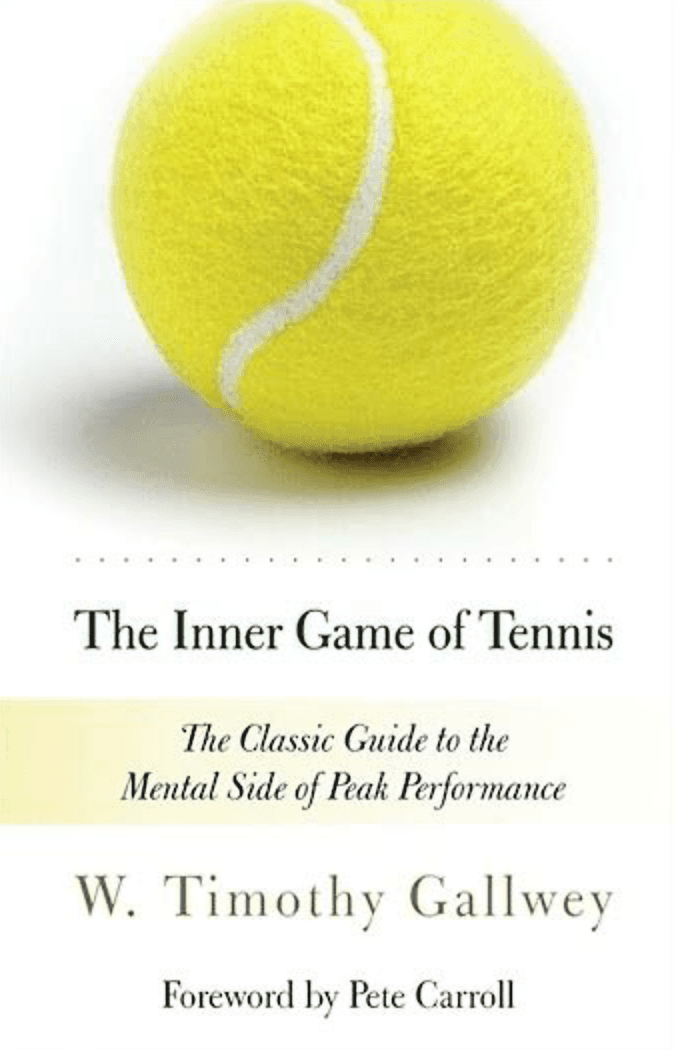
The Inner Game of Tennis by W. Timothy Gallwey explores how the mind affects athletic performance, focusing on the dialogue between two selves. Self 1 represents the conscious, striving part that judges and commands. Self 2 is the natural, automatic learner that performs skills effortlessly when left undisturbed. Gallwey argues that the real opponent in sports isn’t another player but the interference arising from Self 1’s doubts, fears, and overthinking.
Gallwey begins by illustrating how mental interference can ruin a simple action like serving. He recounts sessions with players who tense up, tighten their grip, and stiffen their bodies. When they relax, drop judgment, and trust their natural coordination, the serve flows smoothly. This shift from force to ease marks the core of the inner game.
The author introduces awareness through recording and replay techniques. He instructs readers to notice sensations—foot pressure, racket feel, and ball contact—without labeling them good or bad. This nonjudgmental observation redirects attention from outcome to process. As players focus on feeling rather than fixing, their performance often improves without conscious effort.
Gallwey contrasts traditional coaching with his inner game approach. Conventional methods rely heavily on external instruction and correction. He views them as amplifying Self 1’s critical voice. By comparison, his method encourages Self 2 to learn through discovery, using minimal guidance and maximum self-awareness.
A key exercise involves visual imagery to prime the subconscious mind. Readers are asked to visualize the ball’s trajectory, the swing’s arc, or the footwork pattern before hitting. This mental rehearsal aligns Self 1’s intentions with Self 2’s execution. It also reduces distracting thoughts, allowing the player to move spontaneously and fluidly.
Throughout the book, Gallwey emphasizes the importance of trusting Self 2. He warns against micromanaging every detail. Instead, he suggests setting broad targets—like aiming for the baseline’s center—then stepping back. The less Self 1 interferes, the more Self 2 adapts. The result feels effortless yet precise.
Gallwey also explores the role of tension and relaxation. He guides players to sense muscle tightness and deliberately let it go. He likens the process to loosening a spring so it can snap back freely. This ease in the body translates to smooth strokes and better timing on the court.
Another chapter delves into mental distractions: fears of failure, memories of mistakes, and preoccupations with winning. Gallwey advises acknowledging these thoughts like clouds passing in the sky. He recommends returning attention gently to the present moment. This practice resembles mindfulness techniques later popularized in sports psychology.
The book doesn’t ignore technique entirely. Gallwey offers concise pointers on grip, stance, and swing mechanics. Yet he frames these as support tools, not rigid rules. They serve as landmarks for awareness rather than prescriptions for perfection. Players who cling to them too tightly risk boosting Self 1’s critical chatter.
To reinforce learning, Gallwey suggests keeping practice sessions short and varied. He proposes alternating drills with free play and spontaneous games. This variety prevents boredom, challenges Self 2, and keeps Self 1 from fixating on minor flaws. Players stay engaged and discover solutions organically.
Gallwey shares anecdotes from his own lessons to illustrate breakthroughs. He recounts moments when frustrated students suddenly find “the zone,” landing shot after shot without conscious effort. He never claims credit for these epiphanies but highlights the student’s shift in focus and trust. Such stories bring his theories to life.
The Inner Game of Tennis extends beyond tennis. Gallwey describes applying his methods to business presentations, music, and any skill requiring coordination and focus. He shows how anyone can reduce internal resistance by observing, trusting, and letting go. The principles remain the same: notice without judgment, trust natural learning, and play the inner game.
In later chapters, Gallwey tackles performance anxiety and competitive pressure. He urges players to frame competition as a chance to learn rather than a threat. By making each point an experiment, they detach from ego-driven outcomes. This perspective shift often leads to calmer nerves and sharper play.
Finally, Gallwey underscores that mastery is an ongoing journey. He reminds readers that occasional dips and mistakes are part of growth. He encourages them to remain curious and patient with themselves. Over time, the inner game becomes a way of life—on and off the court—fostering greater confidence, joy, and authentic performance.
By weaving theory, exercises, and stories, The Inner Game of Tennis offers a balanced, human approach to learning and performance. Gallwey’s emphasis on simplicity and self-discovery resonates with anyone seeking to overcome mental blocks. His message is clear: play the mind’s inner game, and watch your game on the court transform.
DETAILED SUMMARY
Key Takeaways
1. Mastering the Two Selves
“All that matters is not what goes on outside, but what goes on inside you.”
Self 1 vs. Self 2: Gallwey introduces Self 1 as the judgmental mind that criticizes and instructs. Self 2 is the natural, intuitive part that performs actions. He argues that Self 1 often gets in the way by overthinking and creating tension.
He shows how tension and self-criticism harm performance. By learning to quiet Self 1, players let Self 2 execute smooth strokes. The inner game, then, hinges on cultivating trust in that intuitive self.
From Tennis to Life: Understanding these two selves helps beyond sport. In any skill—public speaking, writing, or work—self-doubt can undermine performance. Recognizing inner critics allows people to step back and tap into flow.
Organizations now apply this idea to team dynamics. Rather than micromanage, leaders encourage autonomy. That shift fosters creativity and reduces burnout.
Key points:
- Self 1 judges and instructs
- Self 2 is natural and intuitive
- Quieting Self 1 improves performance
- Applicable to sports and daily tasks
- Leads to greater flow and autonomy
2. The Focused Mind
“Concentration without tension is the essence of inner game.”
Relaxed Concentration: Gallwey emphasizes concentration that feels effortless. He asks players to focus on the seams of the ball or the gentle clap of the racket strings. By narrowing attention to simple, clear tasks, the mind relaxes.
This relaxed focus stops the mind from wandering to past mistakes or future worries. It trains awareness and deepens present-moment engagement.
Sharper Performance: When tension dissolves, the body moves more freely. Studies in sports psychology confirm that athletes in flow states react faster and more accurately. Teams use mindfulness drills derived from this approach.
In education, teachers incorporate brief focus exercises to help students settle. That practice improves retention and reduces test anxiety.
Key points:
- Effortless attention on simple cues
- Prevents mind from drifting
- Promotes flow states
- Backed by sports psychology research
- Adopted in education and workplaces
3. Learning Through Observation
“Watch the ball, not yourself.”
Non-judgmental Awareness: Gallwey advises players to observe their actions without judgment. When a stroke goes awry, they simply note its path, speed, or bounce. That observational stance sparks self-correction instead of panic.
By focusing on external feedback, players learn faster. They bypass negative self-talk and give clear messages to the body.
Efficient Skill Development: This principle underpins many modern coaching methods. Rather than overload athletes with verbal instructions, coaches film sessions and let players review their form. That visual feedback echoes Gallwey’s observational approach.
In therapy and parenting, a non-judgmental stance builds trust. When people feel observed rather than criticized, they open up to change.
Key points:
- Observe without labeling events
- Use clear external feedback
- Avoid negative self-talk
- Accelerates skill learning
- Influences coaching and therapy
4. Trusting the Body’s Wisdom
“Let your body discover the correct way to swing.”
Hands-Off Learning: Gallwey recommends minimal verbal guidance and more trust in the learner’s capacity. He illustrates how telling a student to ‘keep the racket face open’ often backfires. Instead, he has them feel the racket’s balance.
That tactile awareness prompts the body to adapt naturally. The learner internalizes movement patterns instead of forcing them through instructions.
Empowering Autonomy: This hands-off approach resonates in self-directed learning trends. Online courses and workplace programs encourage exploration and peer support over top-down mandates. People retain more when they discover concepts themselves.
Even in physical rehab, therapists now favor guided movement rather than repetitive drills. Patients gain confidence by trusting their bodies.
Key points:
- Minimal instruction fosters discovery
- Body adapts through feel and balance
- Boosts learner autonomy
- Influences e-learning and rehab
- Builds confidence
5. Letting Go of Results
“It’s not about winning or losing. It’s about playing.”
Process Over Outcome: Gallwey stresses focusing on the process rather than the scoreboard. When players obsess over winning, anxiety spikes and performance drops. Instead, he urges them to enjoy each rally and each smooth stroke.
This mindset shift cultivates resilience. Players treat mistakes as data, not failures.
Sustainable Motivation: In business, outcome-obsessed cultures lead to stress and high turnover. Companies that value learning processes over immediate results report higher engagement. Employees innovate more when they feel safe to fail.
Athletes who adopt a process mindset often recover faster from losses. They retain joy in their sport and avoid burnout.
Key points:
- Emphasize practice over victory
- Reduces performance anxiety
- Views mistakes as learning
- Boosts long-term motivation
- Applied in corporate culture
6. Harnessing Inner Dialogue
“You are only as free as your thoughts allow you to be.”
Managing Self-Talk: Gallwey highlights how repetitive thoughts shape action. Negative self-talk tightens muscles and breaks rhythm. He offers simple word exercises—like repeating ‘bounce’—to anchor attention.
These verbal cues replace harsh inner critics with neutral prompts. The body then responds more fluidly.
Better Mental Habits: Modern neuroscience confirms that thoughts can rewire neural pathways. Athletes and executives use positive cue words to instill calm under pressure. Apps now guide users through brief mental drills to build these habits.
Therapists adopt similar tools for clients suffering from anxiety or ADHD. By reframing self-talk, people regain control over impulse and focus.
Key points:
- Inner dialogue shapes body response
- Use neutral cues to anchor focus
- Replaces negative self-criticism
- Supported by neuroscience
- Used in therapy and tech
Future Outlook
Gallwey’s ideas still guide how we learn, teach, and perform. His emphasis on non-judgmental awareness and trust in innate ability paved the way for mindfulness practices in sports and beyond.
Looking ahead, we’ll likely see deeper integration of inner-game principles with brain-computer interfaces. As technology maps brain states, personalized focus drills could tune Self 1 and Self 2 dynamics in real time.
Meanwhile, educators and leaders will continue to favor process over outcome. By fostering environments where learners trust their own discovery, we’ll unlock creativity and resilience across fields.







