SUMMARY
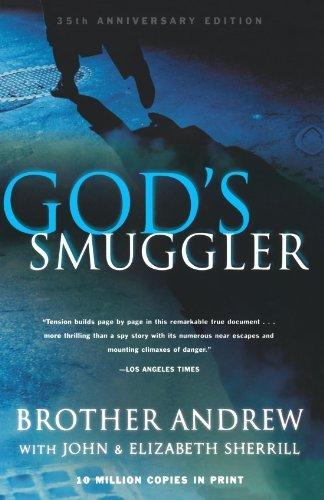
God’s Smuggler by Brother Andrew recounts the daring journey of a young Dutchman who decided to trust God with every step. Born as Andreas van der Bijl in 1928, he grew up in a small town near Utrecht, the son of strict Christian parents. He served in the Dutch army after World War II, where he first sensed a call to help persecuted Christians in Eastern Europe. That call became impossible to ignore once he witnessed believers risking everything for their faith.
After leaving the army, Andrew worked in a textile business but felt restless. He prayed for guidance. One night, he sensed God telling him to travel behind the Iron Curtain with Bibles tucked in his luggage. He had no training, no permit, and no plan—only a conviction that God would guide his every move.
His first trip took him to Warsaw, Poland. He arrived with a pocketful of Scriptures and an unshakable belief in divine protection. Customs officers inspected his bag and discovered the contraband. Andrew feared arrest, yet nothing happened. The officers glanced at him, smiled, and let him pass. He credited that moment to God’s providence.
In Prague, Andrew found a small circle of underground believers meeting in basements. He handed out Bibles and watched tears flow as people held the Word for the first time. He joined them in prayer for their families and nation. The risk felt real: if the secret police burst in, everyone would face prison. Still, Andrew sensed God’s presence strengthening each voice.
Each trip grew bolder. Andrew learned to hide Bibles inside hollowed-out shoes and disguised them as piece goods. He befriended border guards—sharing cigarettes or jokes—to distract them during inspections. Once, a guard invited him to share tea, never spotting the smuggled Scriptures under his coat. Andrew realized that compassion and simple friendship disarmed suspicion better than any bribe.
Back home in Holland, Andrew rallied friends to join his cause. They formed the organization Open Doors, dedicated to supporting persecuted Christians worldwide. Andrew taught them to trust God in dangerous settings. He drilled them on concealment methods, border codes, and prayer discipline. Soon, a steady flow of Bibles reached behind the Iron Curtain.
Not all missions went smoothly. In one border town, Andrew’s car broke down. He stepped onto frozen ground as storm clouds gathered. Locals offered to fix the engine only if he handed over his hidden cargo. Fear trembled in his heart, yet he prayed for courage. He offered the tools instead, claiming the car needed new parts. The villagers accepted, and he drove off into the night.
Andrew also smuggled evangelists, church literature, and even Bibles for children. He learned local languages—Polish, Russian, Bulgarian—to blend in. He sat in crowded train compartments, pretending to nap, as a suitcase of Scriptures rested in his lap. He chased trains at midnight, hopped over fences, and crawled through muddy fields, all convinced God would shield him.
Through Open Doors, Andrew coordinated aid shipments. Food, blankets, and medicine joined the Bibles in secret warehouses. Volunteers risked prison to distribute these parcels. Churches inside closed countries offered safe houses. Andrew marveled when guards overlooked convoys, chalking it up to prayer or kindly bribes.
By the 1970s, Andrew’s smuggling network reached Asia, Latin America, and parts of Africa. He visited underground churches in Iran, where believers met in private homes under threat of execution. He slipped in Bibles and cassette tapes of sermons. In Guatemala, he trekked through jungles to reach isolated villages, carrying lanterns and blankets alongside Scriptures. Each person he met clung to hope.
Despite close calls with secret police and corrupt officials, Andrew never lost confidence. He described God’s daily guidance in uncanny ways: doors opening at the right moment, sudden changes in patrol patterns, or friendly locals appearing at his side. He saw these interventions as proof that his mission came from beyond himself.
In later years, Open Doors expanded into relief work after natural disasters. Andrew sent teams to rebuild churches after earthquakes and floods. He trained pastors in leadership and compassion. The organization’s focus shifted from smuggling Bibles to empowering persecuted communities in practical ways.
Andrew’s book shares vivid anecdotes of midnight border crossings and tense interrogations. He recalls praying aloud when guards held loaded guns at his head. He recounts meeting exhausted mothers in Romania who hugged their children as if the Word he brought would protect them. These stories pulse with urgency and faith.
God’s Smuggler also explores Andrew’s personal struggles. He admits moments of doubt and physical exhaustion. He mourns friends who suffered imprisonment or worse. Yet in every trial, he found a renewed sense of God’s presence. He learned that risk and sacrifice deepen faith.
By the end of the memoir, Andrew reflects on how far the church has come—even in closed nations. He urges readers to pray for persecuted believers and to stand in solidarity. He reminds us that prayer can penetrate walls and that a single Bible can light up a dark heart. Brother Andrew’s life shows that obedience to God carries unstoppable power.
God’s Smuggler inspires modern Christians to trust God boldly. It invites readers into a world where faith overcomes borders and barriers. Through Andrew’s eyes, we glimpse believers risking life and limb for a single message of hope. It remains a stirring testament to what happens when one person dares to follow God’s call without reservation.
DETAILED SUMMARY
Key Takeaways
1. Answering a Divine Call
“When God speaks, you had better move.”
Sense of Calling: Brother Andrew recalls the moment he felt God’s clear nudge to take Bibles behind the Iron Curtain. He stood in a small Dutch church, leafing through a worn copy of Scripture. Suddenly he sensed a strong inner voice telling him to risk everything for believers in hostile lands.
That conviction changed his life. He traded in his comfortable trucking routes for smuggling operations. He accepted that danger and uncertainty would mark his path. Yet he found that the deeper his trust, the stronger his resolve became.
Launching a Movement: Andrew’s decision inspired others to join the cause. Young Christians across Europe rallied behind his daring missions. They formed the foundation of what became Open Doors, a network dedicated to supporting persecuted believers globally.
By answering that call, he demonstrated how a single person’s obedience can spark widespread change. Governments remained unaware at first. But as shipments of Scripture crossed borders, underground churches swelled. Communists had not expected Bibles to find their way in, and that surprise shifted the spiritual landscape behind the Wall.
Key points:
- Heeding a clear inner conviction
- Leaving a safe life for daring work
- Trusting in God’s guidance under risk
- Spurring growth of a support network
- Changing hearts in closed societies
2. Ingenuity in Smuggling
“I learned early that statutes don’t stop the Spirit.”
Creative Strategy: Andrew describes the countless tricks he perfected. He hid Bibles in tire rims, sewing machines, even fruit crates. He improvised false bottoms in suitcases and held prayer as he passed through customs checks.
He studied each border guard’s routines and used everyday items to conceal truth. He turned simplicity into sophistication. Every mission demanded fresh ideas. Each narrow escape bred new tactics that others could copy.
Practical Legacy: These methods became blueprints for thousands of volunteers. Open Doors compiled detailed guides on concealment and border patterns. New teams borrowed Andrew’s codes and maps to ship literature into North Korea, China, and the Soviet Union.
Customs officials eventually grew perplexed. They searched cars, trains, even animals, but Bibles seeped through. This ingenuity taught persecuted churches they were not helpless. They learned resourcefulness can undermine tyranny, and that truth often travels by clever means.
Key points:
- Hiding Bibles inside everyday items
- Studying guard patterns meticulously
- Adapting to new security measures
- Scaling methods for global teams
- Empowering underground churches
3. Faith under Fire
“They may lock me up, but they can’t imprison my soul.”
Enduring Persecution: Volunteers faced arrest, interrogation, and threats of torture. Andrew recounts nights in dank cells, Bible notes hidden in his socks. He describes how he sang hymns quietly under a thin mattress, sustaining hope.
Prison days taught him that faith doesn’t fade when walls close in. He saw fellow believers emerge stronger. In hostility he discovered a new depth of trust. This steadfastness inspired him more than any miracle or escape.
Strengthening Believers: News of his imprisonment spread quickly among underground congregations. When a border agent tried to force him to renounce his work, Andrew stood firm. That witness emboldened many to resist pressures themselves.
Soviet dissidents began quoting his story in secret meetings. They realized that the human spirit sustains best when anchored in conviction. The chains that bound bodies couldn’t touch beliefs. In that realization, persecuted Christians found a power greater than fear.
Key points:
- Arrests and prison cells
- Secret worship under surveillance
- Resilience of the human spirit
- Inspiring underground faith
- Overcoming fear through conviction
4. Prayer as Strategy
“God works at the speed of prayer.”
Dependence on God: Andrew stresses that every trip began on his knees. He mapped out routes, then asked for guidance on details he couldn’t know. He believed that God opened doors no human hand could budge.
He tells of times when midnight prayers led him to switch flights or delay a border crossing. He credits answered petitions for smuggling thousands of Bibles safely. To him, prayer was an active tool, not a last resort.
Mobilizing Prayer Networks: Open Doors formed global prayer chains. Churches in the West committed to pray as Andrew travelled. They received updates on each leg of his journey and prayed for specific dangers.
Those prayer chains became lifelines. Volunteers working behind the Wall sensed immediate spiritual reinforcement. They felt accompanied. Leaders in totalitarian states later admitted they noticed a strange calm among those believers. They couldn’t explain it, but prayer had become a hidden shield.
Key points:
- Starting each mission with prayer
- Using prayer for tactical decisions
- Forming international prayer chains
- Linking field workers to church support
- Experiencing peace amid danger
5. Power of Solidarity
“We stood as one, though walls divided us.”
Christian Unity: Andrew shows how isolated believers found connection through shared Scriptures. He recounts secret gatherings in basements and forests, where men and women huddled over the same passages the West had sent.
Those meetings fostered kinship across national lines. Eastern churches knew they belonged to a global body. They received letters from abroad, Bible portions printed clandestinely. That knowledge revived hope when oppression felt total.
Global Church Growth: Solidarity spurred membership behind the Iron Curtain to multiply. The network carried not just books, but prayers, teachings, and moral support. Pastors trained in one country helped congregations in another.
After Communism collapsed, many acknowledged that hidden networks had grown stronger than expected. Without weapons or funds, they had used unity as their banner. Today those once-secret churches form vibrant hubs of evangelical life in Eastern Europe and Asia.
Key points:
- Secret forest and basement meetings
- Shared Scripture across borders
- Letters and clandestine print runs
- Training pastors under cover
- Growth despite isolation
6. Transforming Political Landscapes
“Truth finds its way when you carry it close to your heart.”
Spiritual Influence on Regimes: Andrew argues that smuggling Bibles changed Communist leaders long before the Soviet collapse. He recounts border agents who read passages aloud in disbelief. He tells of secret police officers whose hardness softened after nightly devotions.
Those small shifts in individuals had ripple effects. When enough hearts turned, policies softened. Local authorities became less ruthless. Tolerance edged in, transforminga monolithic system from within.
Historical Turning Point: By the late 1980s, Eastern Bloc countries saw mass movements back to faith. Andrew credits those underground Scriptures for laying that groundwork. He presents interviews with former party members who quit the system after finding Christ.
That wave aided Gorbachev’s reforms. When leaders faced peaceful, prayerful citizens, they realized suppression could backfire. In that sense, God’s Smuggler portrays how nonviolent spiritual action helped change a superpower from the inside.
Key points:
- Agents influenced by Scripture
- Erosion of rigid enforcement
- Waves of recommitted believers
- Link to political reform movements
- Role in Communist decline
Future Outlook
Brother Andrew’s legacy continues to guide modern missions. He showed that bold obedience can outmaneuver the world’s toughest barriers. Today, believers carry Bibles into closed regions using drones, encrypted apps, and micro-printed pages—all echoing his pioneering spirit.
His story reminds future generations that persecution often fuels growth. Where governments try to silence faith, underground networks adapt and flourish. As digital surveillance rises, new methods will emerge, but the principle remains: when you place trust in a higher power, ingenuity and courage follow.
Long after borders shift and regimes fall, the heart of God’s Smuggler beats on. It whispers to anyone who fears speaking truth: keep moving, keep praying, and remember that even the smallest act of faith can reshape history.