Summary
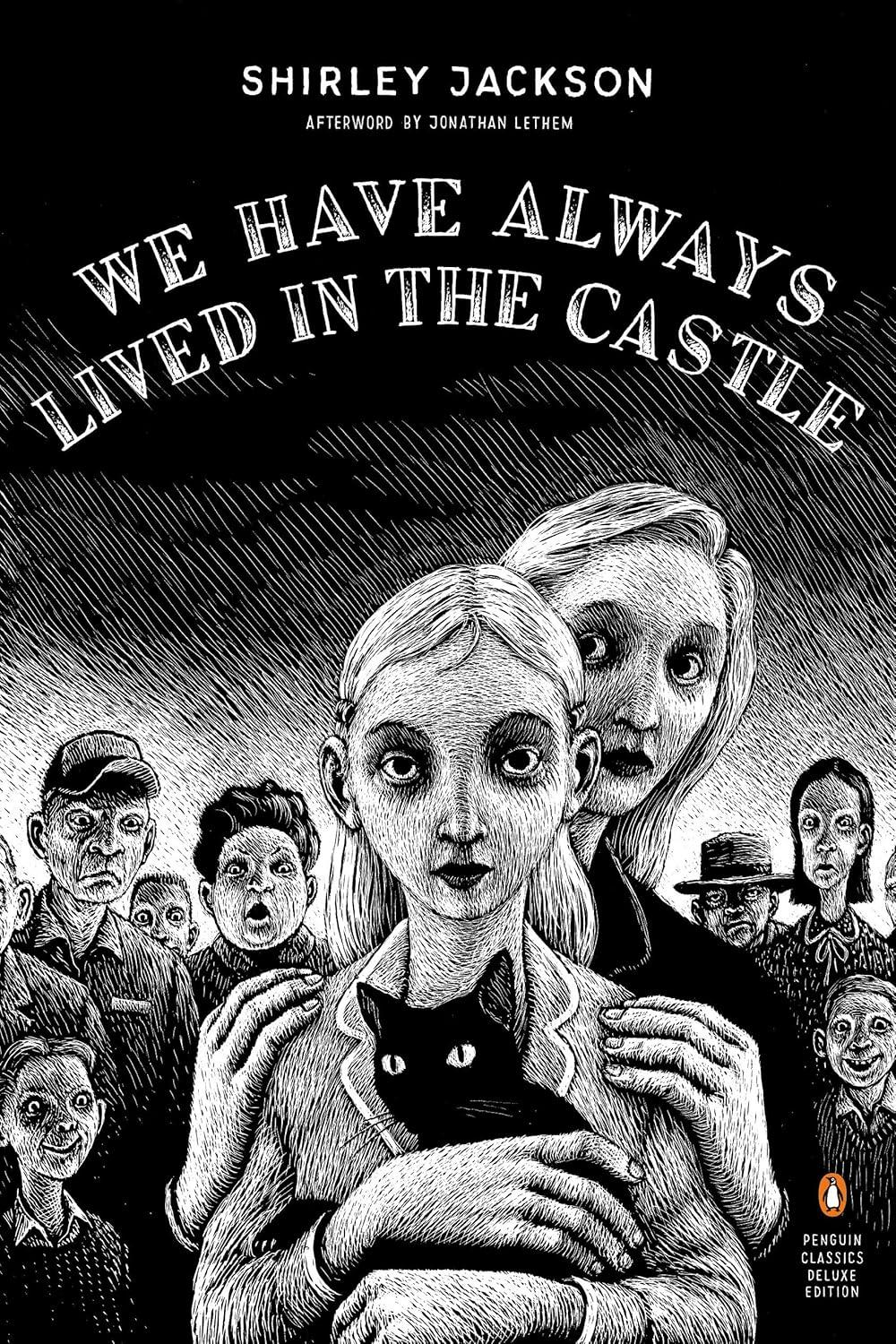
We Have Always Lived in the Castle, by Shirley Jackson, unfolds through the eyes of Mary Katherine Blackwood—called Merricat—who lives in isolation with her sister Constance and their ailing Uncle Julian. Six years earlier, an arsenic-laced sugar bowl killed most of their family at the dinner table, and Constance stood trial for the crime. She was acquitted, but the village never forgave her. Since then, the Blackwoods have barred outsiders and settled into a quiet, ritual-driven life.
Merricat narrates with a mix of whimsy and dark humor, revealing her efforts to keep their world intact. She buries tokens in the grounds around the house, hoping to protect her sisters from harm and ward off unwelcome visitors. Each day follows strict routines: Constance cooks, Merricat scavenges supplies, and Uncle Julian obsesses over his frail memory of the night of the poisoning. Their rooms are an organized chaos of books, trinkets, and protective symbols.
Constance never steps beyond the front porch, haunted by public suspicion and her own guilt. Villagers hurl stones and sneer whenever they catch sight of her through the lace curtains. Merricat, by contrast, ventures beyond the estate to fetch mail or medicine. She has honed a sixth sense for danger, sensing whether she carries good luck or ill will. Her loyalty to Constance drives every ritual and every defiance of the town’s cruelty.
Uncle Julian, once a distinguished history professor, now dwells in a fog of confusion. He spends his hours documenting his memories of the poisoning in disjointed notebooks, hoping to produce a pamphlet called My Family’s Tragedy. Though he drifts in and out of lucidity, he cherishes his guest room view of the family shrubbery. He fixates on Merricat’s treasures as if they might solve the mystery he can no longer piece together.
One day, Cousin Charles arrives, bearing polite smiles and half-veiled demands. He claims to care about family but makes it clear he covets their fortune. Constance greets him warmly at first, hoping for companionship. Merricat spots his calculating gaze and senses danger. Charles lingers in the parlor, studying heirlooms and probing Constance about her late father’s will. He insinuates himself between the sisters, planting seeds of discord.
Charles’s presence unsettles the Blackwood household. He ridicules Merricat’s superstitions and mocks her rituals. He flatters Constance, suggesting she deserves a broader life beyond isolation. Uncle Julian brightens at the company but retreats into his notebooks once Charles begins questioning him. Merricat retaliates with small acts of sabotage—hiding his shaving cream, tainting his tea—but none stop his intrusion.
Tension mounts until one evening, sparks leap across their woodpile. Flames lick the front porch and spread into the lacy curtains. Constance and Merricat snap into action, dousing flames with buckets of water. The fire consumes heirloom furniture and smudges the wallpaper with ash. Amid the chaos, villagers gather below, jeering and tossing stones. The house, once an impenetrable fortress, feels vulnerable.
The next morning, the Blackwoods survey the damage. Constance weeps over her ruined china. Merricat glares at the onlookers. Uncle Julian murmurs half-remembered lines about loss. The fire, though destructive, forges a new bond between the sisters. They decide to abandon their stove-lit kitchen and dine by candle on supplies Merricat cached in the cellar. Their laughter rings out—a small rebellion against both Charles and the hostile town.
Infuriated, Charles confronts Merricat on the porch, demanding explanation for the fire. Merricat holds up her spade—an ornamental pledge she plucked from the garden paths—and warns him to leave. Later, Charles slinks away down the lane, clutching what remains of his dignity. No one ever sees him return. The sisters claim he simply vanished, though rumors swirl that Merricat’s spells proved stronger than his greed.
With Charles gone, the house settles into an eerie calm. Scenes of ordinary life take on a surreal glow: Constance folds laundry by the open windows, while Uncle Julian attempts to rewrite his pamphlet in smudged ink. Merricat reads by lamplight, drifting into dreams of distant forests. The villagers keep their distance, too shy to summon cruelty without Charles’s prompting.
Uncle Julian’s health declines, and Constance devotes herself to his care. Merricat grows more protective, confining herself to the yard and scouring for herbs that might soothe his pain. At night, she lights lanterns at every window, as if guiding friendly spirits home. The siblings settle into a silent accord: they’ll guard each other’s secrets and keep the outside world at bay.
One afternoon, a milkwoman leaves fresh glass bottles at the gate. Merricat picks one up and gently sets it on the porch. Constance smiles, as though she knows the ritual will ensure good fortune. They share a quiet meal in the dining room, free of tension. Uncle Julian hums an unfinished tune. For a moment, the past—and the tragedy—feels safely distant.
Merricat’s narrative winds through odd details: a mole she rescued from a trap, a day she spent burying seven silver coins, a midnight stroll that ended at the hedge. She never stops weaving protective spells, though she sometimes questions their power. Her love for Constance burns brighter than any fear. Constance’s gentle patience anchors Merricat, even on days when paranoia grips her.
In the end, We Have Always Lived in the Castle presents a portrait of two sisters who carve joy from isolation and terror. Jackson’s tale blends gothic dread with wry humor, inviting the reader to wonder whether Merricat’s magic springs from imagination or deeper forces. As snow settles on the black roof, the Blackwoods remain united—protected, at least for now, by the rituals of a girl who would rather bury tokens than face the world outside.
This story lingers after the last page, a haunting meditation on family loyalty and the line between protection and imprisonment. Merricat’s voice—a blend of innocence and cunning—guides readers through a house both sanctuary and prison. In Shirley Jackson’s deft hands, the boundary between safety and danger dissolves, leaving us to ponder where magic ends and madness begins.
Detailed Summary
Plot Summary
1. A Quiet Existence
Mary Katherine "Merricat" Blackwood narrates the isolated life she leads with her sister Constance and their Uncle Julian in the family’s grand estate. They rarely leave the property, save for Constance’s weekly shopping trips to the nearby village. Outside, the villagers regard the Blackwoods with hatred and suspicion, blaming them for the deaths of most of their family by poisoning. They whisper behind their hands, smear threats on the fence, and refuse to speak to Constance.
Inside the house, the sisters maintain a calm routine. Merricat arranges her protective charms—stones buried in the garden and rituals in the drawing room—to keep harmful intentions at bay. Constance tends the home, cooking meals and reading to Uncle Julian. He records his memories of the tragedy in journals, obsessed with reconstructing every detail of that fateful night. The atmosphere is tense yet oddly comforting in its predictability.
Despite the dread beyond the gates, the sisters find solace in each other. Merricat’s voice guides us through hidden nooks in the garden, the moth-laced walls, and the basement where family portraits stare down. Constance’s soft laughter rings through the rooms when Merricat cracks a joke. All seems stable—until Cousin Charles’s unexpected arrival disrupts their fragile haven.
2. Cousin Charles’s Arrival
One morning, Charles comes striding up the long drive, stylish and friendly-eyed. He claims to want to help, to ease Constance’s burdens and restore the family’s fortune. Constance welcomes him gratefully. Merricat stands her ground. She senses Charles’s motives—that he hungers for money and property more than sisterly affection. Yet she plays along, observing his every move.
Charles sits at the dining table, sipping tea with Constance while silently judging the faded wallpaper and moth-eaten carpet. He casually asks the villagers about the Blackwoods, prying for information. Alone with Uncle Julian, he offers to fund his research—but Julian recoils. He clings to his manuscripts, terrified of change. Charles’s polished charm wears Constance down; she invites him to stay.
Merricat starts to feel alarm. She hides his belongings, buries his handkerchief in the garden, and curses him in her rituals. The household routines wobble. Constance’s smiles falter. Julian’s voice grows shrill. Under Charles’s polite gaze, the sisters’ small world twists. Merricat knows she must protect them—no matter the cost.
3. Tensions Rise
Charles redecorates the house in subtle ways. He places his briefcase on the drawing-room table, sheds his gloves on Anne’s favorite chair, and begins making plans to sell family land. Constance, relieved to delegate chores, follows his lead. She lets him move the furniture and handle the accounts. Merricat watches her sister lose confidence. She scrambles to reverse every change once Charles is away.
At supper, Charles presses Constance to consider returning to society. He flatters her cooking, praises her tea. Yet he criticizes the décor as dowdy. Constance falters. She asks Merricat if the new curtains look all right. Merricat lies and says they are fine. Inside, she seethes. She retreats to the garden in twilight, burying more stones and whispering incantations to drive him off.
Uncle Julian senses the strain. His hands tremble when he shows Merricat his journals, now smeared with tea stains—Charles’s cups were left open. He mutters that changes might erase memories and that he fears losing the record of that terrible day. Merricat vows to act swiftly before her sister’s gentle soul is lost to Charles’s schemes.
4. The Night of Fire
One midnight, a fire flares in the attic. Flames lick around the family’s heirlooms. Smoke chokes the corridors. Constance wakes in a panic. Charles races upstairs to fight the blaze while Merricat watches, unmoved, from below. Iron bars lock the windows. The villagers gather at the fence, howling and taunting. They throw stones.
Merricat feels a strange calm. She had planted incendiary talismans among Charles’s things—her final ritual. Now the fire roars according to her design. She stands unmoved as Charles carries Constance out through smoke and ash. Uncle Julian hobbles behind them, coughing. Merricat closes the garden gate, keeping villagers at bay.
In the ruins of the attic, Constance sobs quietly. Charles’s suitcase and clothing lay charred. The fire has driven him away. Village anger remains, but the home feels sealed once more. Merricat returns to her protective circle around the house, convinced she has restored balance. Yet ash drifts down the halls, reminding her peace comes at a cost.
5. Aftermath and Healing
Dawn breaks over the quiet house. Merricat and Constance assess the damage. Charred beams sag, soot coats the walls, and furniture smokes. Yet they feel relief. They call in a local builder—an ally more respectful than Charles—to repair the roof. Constance cleans soot from family portraits. Merricat gathers fallen embers, burying them in the garden.
Inside, the sisters settle back into their routine. Constance bakes bread in the still-warm kitchen. Merricat sets stones around the new repairs, whispering thanks to her unseen protectors. Uncle Julian records the fire’s impact—tentatively, as if afraid change might slip from memory. Outside, the villagers glare across the fence but no longer hurl insults. Morbid curiosity keeps them away.
Life resumes its old rhythm. The sisters sleep side by side. Merricat dreams of talismans glowing beneath the earth. Constance wakes to sunlight on the walls. The world beyond the gates remains dark, but within, stability endures. Merricat senses fate has turned—until, perhaps, the next threat appears.
6. A New Balance
Months later, the house stands restored. Ivy climbs newly painted shutters. The garden—once wild—now has neat rows of herbs and flowers. Merricat trials fresh charms beside old ones. She whispers to the soil. Constance reads aloud from her favorite books, voice steady, welcoming the quiet of the house.
Uncle Julian, pale but determined, finishes his last journal entry. He hands Merricat a worn notebook, the final record of the family’s tragedy and survival. She traces a finger over his script, grateful for his memory. Outside, the villagers still glance but keep their distance. They sense the sisters’ resolve.
At dusk, Merricat and Constance sit in rocking chairs on the porch. Side by side, they watch fireflies rise among the lantern light. No threats stir in the shadows. For now, they have always lived—and will always live—in their castle.
Characters
1. Mary Katherine “Merricat” Blackwood (Narrator and Protector)
“I said to myself that I must do something, that there must be some way to keep him off, so I picked up a stone and threw it. Then I felt a great happiness.”
Merricat serves as both the story’s voice and its guardian. At eighteen, she’s clever, fiercely loyal, and suspicious of outsiders. She uses folk magic—burying objects, casting spells—to shield her home. Her devotion to Constance and Uncle Julian drives every action. Merricat’s world is small yet deeply personal; she sees threats in polite smiles and hidden motives in casual words.
Under her steely exterior, Merricat craves safety and love. She views rituals and symbols as extensions of herself. While some find her odd, she radiates confidence in her role. When Charles arrives, Merricat’s control slips, revealing how fragile her sanctuary truly is. Her choices, though extreme, spring from a desire to protect her family at any cost.
2. Constance Blackwood (Caretaker and Sister)
“Oh, Merricat, dear, don’t you think we ought to be more careful? We can’t go on hiding forever.”
Constance, twenty-four, embodies gentleness and warmth. Accused—and acquitted—of poisoning her family, she has withdrawn into the safety of her home. She dresses simply, speaks kindly, and spends her days cooking and reading to Uncle Julian. Constance’s calm demeanor masks deep anxiety. She yearns for normalcy but fears the world beyond her gates.
Her love for Merricat is fierce. Constance privileges family over all else, trusting Merricat’s judgments. Yet she suffers when Merricat turns abrupt or secretive. Constance’s character grows when Charles appears: she oscillates between independence and dependence. In the end, she reclaims her own voice, choosing her sister’s protection over the suitor’s promises.
3. Charles Blackwood (Interloper and Antagonist)
“Constance, you can’t spend your life in this lonely house. People will think you’re dead up here.”
Charles, the family’s cousin, arrives as a polished stranger. He presents himself as charming, offering financial help and company. Yet his motives center on control of the Blackwood fortune. His polite smiles mask greed. Charles unsettles the household with his casual judgments and subtle demands.
He sees Constance as a prize—beautiful, vulnerable, and ripe for influence. He underestimates Merricat’s devotion, thinking forced civility can shatter the sisters’ bond. When his schemes fail, Charles’s charm cracks, revealing desperation. His departure by smoke and flame underscores the sisters’ fierce loyalty and his inability to penetrate their world.
4. Uncle Julian Blackwood (Family Chronicler)
“I’m afraid changes will wipe it out. I must have every scrap of memory to keep us from forgetting.”
Uncle Julian, once a physician, now lives haunted by memories. He recorded the poisoning incident in sprawling notes, desperate to preserve every detail. His health has declined; he shuffles through rooms with tremulous hands and a mournful gaze. Yet his mind remains sharp when he speaks of the past.
He depends on Constance and Merricat for care but resents any change. Julian values memory above comfort. He fears any alteration of the house may erase his precious records. His journals frame the narrative, providing context and emotional weight. His final acceptance of the repaired home marks a fragile resilience.
5. Mrs. Wright (Villager and Obstacle)
“They’re witches, I tell you. Poisoners. They’ve got devils in that house.”
Mrs. Wright heads the local prejudice against the Blackwoods. She organizes the daily gossip, scrawls curses on the fence, and rallies the women to boycott Constance’s tea. She sees her actions as righteous retribution for past wrongs. Stern-faced and ever-watchful, she wields collective fear like a weapon.
Despite her hostility, Mrs. Wright’s fear is clear: she worries about dark powers in the Blackwood house. She feeds on community outrage yet also serves as the sisters’ unwitting protector—keeping neighbors at bay. Her influence shifts after the fire: villagers recoil, unsure whether to aid or condemn. In that uncertainty, Mrs. Wright’s power falters.
Themes Analysis
1. Isolation and Safety
Jackson explores how isolation protects and imprisons. The sisters’ seclusion shields them from prejudice yet deprives them of growth. Inside their walls, they shape reality. Merricat’s charms and Constance’s routines form a fortress against hostile forces. Yet that very fortress stunts their ability to trust anyone else.
Their safety demands constant vigilance. Each ritual, each barred window, underscores the cost of solitude. Isolation breeds both comfort and fear. When Charles appears, the walls tremble, revealing how precarious their haven really is. In the aftermath of the fire, the sisters choose isolation again—preferring emotional safety over the risk of human connection.
2. Power and Control
Control fuels every relationship in the novel. Merricat controls through magic and routines, Charles through charm and financial threats, and villagers through collective scorn. Constance’s power lies in forgiveness and domestic skill. Each character wields influence differently, yet all strive to shape outcomes.
When Merricat’s spells send Charles away, she reasserts control over her world. The act reveals Jackson’s commentary on moral ambiguity: power can protect loved ones but also justify extreme actions. Control becomes a double-edged sword—granting security while risking cruelty.
3. Memory and Trauma
Uncle Julian’s journals testify to the weight of past tragedy. Memory haunts every corner of the house—faded photographs, soot-stained journals, and whispered recollections. The poisoning event shapes each character’s psyche. Constance freezes, unable to fully step back into life. Merricat resorts to magic to ward off reminders of pain.
Trauma fractures reality. Characters cling to memories or bury them beneath spells. Jackson suggests that true healing requires facing the past. Yet the sisters choose rituals over therapy, sealing their wounds in secrecy. The fire symbolizes both destruction and renewal—burning painful relics so new memories can take root.
Key Plot Devices
1. Protective Magic
Merricat’s folk rituals form the novel’s core structure. She buries objects, draws symbols, and casts spells to safeguard her family. These acts create an aura of enchantment around the estate, shaping atmosphere and plot. Each charm ties Merricat’s psyche to the land; when Charles disrupts her rituals, he breaches her inner world.
The magic also highlights Jackson’s subtle supernatural undertone. It remains ambiguous—are Merricat’s spells real or psychological? Either way, they drive Charles away. Magic serves as metaphor for the sisters’ coping strategies, illustrating how the mind can craft defenses in the face of danger.
2. Uncle Julian’s Journals
The journals provide exposition and emotional resonance. Julian’s obsessive notes on the poisoning fill gaps in the narrative, revealing family dynamics and unanswered questions. They serve as a frame, anchoring Merricat’s subjective view to a “factual” record.
The journals also underscore memory’s fragility. Tea stains, charred pages, and missing sections hint at deliberate erasure. After the fire, Julian worries that his work is lost forever. His manuscripts become symbols of truth struggling against time, change, and Merricat’s protective interventions.
3. The Fire
The attic fire marks the climax, physically and psychologically altering the sisters’ world. Set by Merricat’s final ritual, it destroys Charles’s belongings and his hold over Constance. Flames consume symbols of outside influence—briefcase, documents, and clothing—leaving the house intact beneath.
As a device, the fire conflates purgation and menace. It purges the interloper and cements the sisters’ unity. It also reflects Jackson’s theme of destruction as renewal. In the charred ruins, the sisters rediscover domestic peace. Yet the threat of repeating violence lingers in ember-stained floors and smoke-dark walls.







