
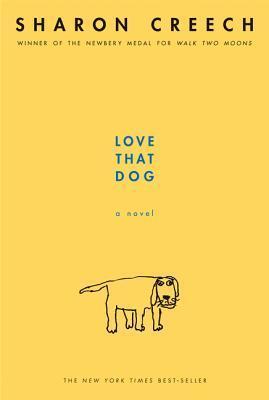
Summary
Love That Dog by Sharon Creech unfolds through a series of free‐verse journal entries written by a young boy named Jack. His teacher, Miss Stretchberry, asks the class to write poetry, and Jack resists at first. He opens his notebook with a single line: “I hate poetry.” Over time, his entries grow warmer and more open, showing how his attitude toward poetry—and toward his own feelings—begins to shift.
At the start, Jack writes short, clipped notes. He insists that poetry is pointless and that he won’t write more than a few lines. His entries often include doodles of baseballs or dogs instead of words, suggesting that he’d rather sketch than express himself in verse. Miss Stretchberry gently urges him on, quoting famous poems like Walter Dean Myers’s “Love That Boy.” Jack protests but seems curious.
One day, Jack’s teacher reads “Love That Boy,” a poem about a father’s pride in his son. When she shares lines like “He sits like a king,” Jack reacts without reasoning. He draws a picture of a dog—no, a cat—giving the cat a crown. His confusion feels real: the poem touches something he can’t yet name. Still, he writes a few more lines and adds a sketch of a crown floating above a slumped figure.
Jack’s entries begin to lengthen. He writes about being told to describe a dog, so he writes “A dog is a soft thing.” When Miss Stretchberry praises the simple line, Jack seems startled. He tries again, this time writing about a red wheelbarrow, echoing William Carlos Williams. He copies fragmentary phrases and then watches them change in his mind. The poem becomes a lens, and he dips more into it.
As weeks pass, Jack’s notebook fills with small poems and sketches. He imitates Robert Frost’s imagery of snowy woods, by describing his own backyard after a rainstorm. He writes about the muddy grass and the way the world shines oddly when water beads on leaves. His teacher encourages him to go deeper, asking what he feels. Jack hesitates, then scribbles, “I feel muddy.”
A turning point comes when Miss Stretchberry reads “Where the Sidewalk Ends” by Shel Silverstein. Jack laughs at the funny drawings and the playful rhymes. He writes a poem about missing his dog, Sky, who ran away. His lines are shaky but sincere: “Sky was blue / and Sky was soft / Then Sky ran off.” The class claps. Jack blushes, surprised by the applause.
Jack begins to share more. He writes about school lunches, recess fights, his best friend—Ivy? No, that was someone else. He names her Lola. He writes about Derek, who teases him. The teasing makes Jack’s words sharper. He experiments with rhyme: “Derek laughs / I want to cry / But words can’t always / Tell me why.” He underlines “cry.”
One entry reveals a deep wound. Jack writes about his father, who died before he was born. The mention comes almost in passing: “They say Dad was a dog man. He’d take me hunting.” Jack imagines bone-dry fields and empty skies. His poem breaks at the end: “I wish I knew him.” He leaves the rest blank.
That empty space unsettles Miss Stretchberry. She invites Jack to read the poem aloud. His voice cracks. He stumbles on “wish.” The class listens in silence. One student whispers, “He’s brave.” Jack pushes himself to the end. He ends with a little sketch of two footprints side by side.
After that day, Jack writes steadily. He studies Mary Oliver’s “Wild Geese,” and scrawls birds in flight above his words. He writes, “Birds go home and so will I,” and for the first time, he adds a date. The teacher smiles and pins his poem on the wall along with others from the class.
Jack’s final entries document a class project: each student must write an “I Am” poem. Jack hesitates but then composes, “I am / the empty space / between two leaves / waiting to grow.” He draws a sprout. His words flow more freely now. He experiments with stanza breaks, indents, even a small acrostic. He signs his name at the bottom.
When Jack’s notebook nears its end, Miss Stretchberry asks him to choose a favorite poem. Jack picks his dog poem, the one about Sky, but revises it. He adds lines: “Sky was lost / but finds me inside these words.” He grins when he reads it to the class. They cheer.
The last entry is short but full of feeling. Jack writes, “Thank you.” He draws a small heart around the phrase. Below, he adds a final sketch: a boy and a dog walking under a sky with words drifting above them. It mirrors the first doodles, but now the notebook feels complete.
Love That Dog ends with a sense of hope and growth. Jack has discovered that poetry can hold loss, humor, and surprise. He’s found a way to speak for himself when words once felt heavy. Sharon Creech’s novel shows how a young boy moves from resistance to acceptance, finding in poetry a path to truth and healing.
By structuring the story as Jack’s journal, Creech lets us witness a boy’s inner world opening line by line. Each poem, sketch, and pause reveals a step in his journey. The final image, of boy and dog walking together, suggests that language can bridge absence and presence, memory and imagination. Love That Dog celebrates the power of words to shape our lives, one verse at a time.
Detailed Summary
Plot Summary
1. Jack’s Reluctant Start
Jack opens his journal with a firm refusal to write poetry. He insists, “I don’t want to do it,” and his pages stay blank. Yet, his teacher, Mr. Davies, gently nudges him to try a simple poem. He shares an example by Walter Dean Myers, and Jack scribbles a few lines in response.
Despite his stubborn tone, Jack’s entries reveal a flicker of interest. He tries rhymes about flowers but then crosses them out. His frustration shows. He ends the day with a single word: “poem?”
This early resistance sets the stage. Readers see his voice emerging from silence. They sense that something deeper lies behind his teasing tone.
2. The Memory of Spot
Mr. Davies asks Jack to write about his dog. Jack’s pages fill with short, stilted lines describing Spot’s wagging tail. He writes, “Spot ran in circles / and barked. / He was happy.”
He crumples these lines too. Yet grief seeps in. He admits, “I miss him.” Those three words carry more weight. His raw tone hints at unresolved pain.
By the end of this arc, Jack tangles emotion with humor. He pokes fun at his own lines yet can’t hide sorrow. His dog’s memory drives him deeper into writing.
3. Amy’s Poem and Jack’s Response
Amy, a classmate, reads a poem about her pet with tears. Jack watches, curious. He jots: “I don’t cry.” That claim rings hollow. He asks Mr. Davies for another poem example.
Reading a William Carlos Williams piece, Jack admires its simplicity. He tries free verse, describing Spot under the tree. His words flow more easily now. He ends with, “He rests.”
This moment marks a shift. Jack learns that poetry can hold both sadness and honor. He starts to see writing as a safe place for his feelings.
4. Confronting Loss
Mr. Davies invites the class to write a poem about what scares them. Jack hesitates, then writes about the emptiness after Spot’s passing. His lines stutter: “The house is too quiet.”
He pauses mid-entry, revises, then rescues the stanza. The broken rhythm and line breaks mirror his grief. He doesn’t mention tears yet. Instead he writes, “I hear nothing.”
Here Jack confronts loss head-on. His voice grows honest. Readers feel the damp hush of an empty home. His poems become vessels for his unspoken sorrow.
5. From Imitation to Authentic Voice
At one point, Jack imitates William Blake’s style, sketching doodles around his text. He rhymes “dog” with “log” but crosses it out again. He realizes forced rhymes feel fake.
Encouraged by Mr. Davies, he drops rhyme schemes altogether. He writes simply about Spot’s fur. His free-verse lines carry images: “soft / like old cotton shirt.”
Jack’s words gain confidence. He claims his voice, messy and real. He’s learned that poetry needs heart more than rules.
6. Final Tribute
In the closing entries, Jack writes a longer poem without erasing a word. He addresses Spot directly: “I remember you.” He thanks him for friendship and loyalty.
The formatting grows bold. He experiments with spacing to show pauses. His last lines read: “I love that dog.” They stand alone on the page.
Jack has transformed. His pages began with protests and ended in praise. The journey from silence to a genuine tribute completes his arc.
Characters
1. Jack (Protagonist)
“I don’t want to write a poem. / I want to write about my dog.”
Jack narrates his own story through free-verse journal entries. He starts by refusing to write poems, claiming it’s “for girls” or “for sissies.” Yet each forced line peels back his defenses. Beneath his teasing tone, he carries deep grief over losing his dog, Spot. His journey unfolds as he learns that poetry can hold loss and love.
By the final pages, Jack embraces his voice. He experiments with form, ditching rhyme schemes that feel false. His honest lines reveal tenderness. Readers watch him transform pain into a simple but moving tribute. His growth embodies the power of words to heal.
2. Mr. Davies (Teacher)
“Poetry doesn’t have to rhyme.”
Mr. Davies guides Jack and his classmates with gentle persistence. He introduces them to poems by real writers and encourages imitation at first. He never forces them. Instead, he models respect for individual voices. His kindness creates a safe space for Jack to explore.
He balances structure with freedom. When Jack struggles with rhyme, Mr. Davies shows him examples of free verse. He leaps from Emerson to Williams to Blake, letting Jack discover what works. Through his quiet support, Jack learns that poetry isn’t about rules—it’s about truth.
3. Spot (Absent Companion)
“You were my best friend.”
Spot never appears alive in the text but remains central to the narrative. Through Jack’s memories, Spot feels real—bounding, barking, wagging with joy. His absence drives Jack’s emotional journey. Each poem addresses Spot directly or recalls shared moments in the yard.
Spot symbolizes unconditional love and loss. He’s the silent listener to Jack’s early frustrations. As Jack writes, Spot’s memory becomes a catalyst for healing. The dog’s presence lingers in the margins of every page.
4. Amy (Classmate and Catalyst)
“I cried—so I know it’s true.”
Amy writes her own poems about her pet, showing raw emotion. When she reads aloud, Jack is surprised by her tears. She becomes a gentle reminder that it’s okay to feel deeply. Her example motivates Jack to try vulnerability.
She doesn’t appear continuously, yet her willingness to share stirs Jack. He watches Amy’s courage and realizes he’s been hiding behind jokes. Her role is small but pivotal in opening Jack’s heart.
5. Ferguson’s Son (Class Rival)
“Squirrels drop / with one quick shot.”
The son of a local boy named Ferguson writes mocking, rhymed poems about hunting trips. He brags about shooting squirrels, calling it “fun.” His rough humor clashes with Jack’s tender recollections.
Through this contrast, Jack clarifies his own feelings. He rejects the playful violence of Ferguson’s son and chooses honesty over bravado. The rivalry, though minor, sharpens Jack’s resolve to find his genuine voice.
Themes Analysis
1. Grief and Healing
Love That Dog treats grief as a process that moves from silence to expression. Jack’s initial refusal mirrors his emotional block. He can’t face the empty collar or the quiet yard. Each poem peels back a layer of denial until he finds words for his sorrow.
By the end, writing becomes cathartic. Jack’s final tribute to Spot shows healing’s beginning. He still misses his dog, but he honors Spot with honest lines. The act of writing lets him carry loss instead of being crushed by it.
2. Voice and Authenticity
Jack’s journey revolves around finding his authentic voice. Early entries mimic poems that feel alien. Forced rhymes and fancy words frustrate him. When he drops imitation, his language flows. He writes in short bursts, pauses, and fragments that reflect how he speaks.
This authenticity extends beyond style. Jack’s true self emerges—his humor, pain, and love. The text argues that real poetry comes from truth, not rules. Authentic voice, it suggests, is the most powerful poetic device.
3. Power of Mentorship
Mr. Davies exemplifies how a caring mentor can unlock creativity. He never scolds Jack for crumpled pages or rude poems. Instead he offers examples and praise. He knows when to guide and when to step back.
Through his quiet patience, Mr. Davies shows that learning grows in safe spaces. Jack responds best when he feels supported. The theme highlights how trust and respect between teacher and student fuel growth.
Key Plot Devices
1. Free-Verse Format
The novel uses free verse to mirror Jack’s evolving emotions. Short lines and varied spacing show pauses in his thoughts. When he hesitates, the lines break. When he gains confidence, they flow more smoothly.
This device draws readers into Jack’s mind. We sense the stutter of his grief. We see the clearing of his heart as lines lengthen or tighten. Free verse becomes the perfect vessel for a boy finding his voice.
2. Intertextual Poem Samples
Mr. Davies introduces poems by real poets—Walter Dean Myers, William Carlos Williams, and more. These samples serve as scaffolding. Jack imitates them at first, learning form and style.
As he grows, his departures from these models show his development. When he abandons rhyme schemes or formal stanzas, it marks a turning point. The intertextual device threads Jack’s story into a wider poetic tradition.
3. Direct Address to Spot
Jack often writes as if he’s speaking to his dog. Lines begin with “You” or name Spot directly. This direct address blurs the line between poem and letter. It personalizes each entry.
The device heightens intimacy. Readers feel Jack’s longing in each sentence. By addressing Spot, Jack invites us into his private grief. His final lines—“I love that dog”—land with the force of a farewell letter.







