Summary
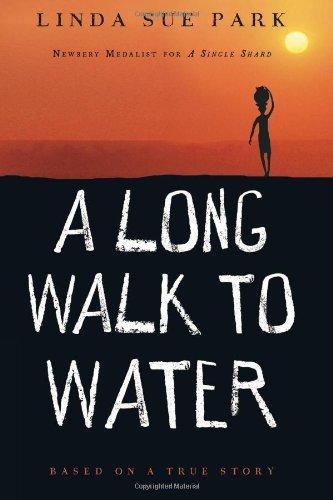
A Long Walk to Water, by Linda Sue Park, tells two parallel stories set in Sudan. One follows Salva, an eleven-year-old Nuer boy in 1985 whose life shatters when civil war erupts. The other centers on Nya, a young girl in 2008 who spends hours fetching water each day. Though separated by time, their journeys intertwine around the search for safety and clean water.
Salva’s tale begins in his village school when he hears gunfire. Chaos erupts and he flees into the bush, afraid to look back. He gathers with other boys and learns that adults have been killed. Confused and alone, he vows to find his family even though the fighters patrol the roads.
As days pass, Salva joins a group of Dinka refugees led by an old man named Jewiir. They trek north through blistering heat, stopping at a dry riverbed for brief rest. Salva watches friends collapse from thirst, but he steels himself and moves on with the others. Each morning, they rise before sunrise to avoid the worst heat.
The group reaches a refugee camp at Itang in Ethiopia. Salva finds shelter there and sleeps with hundreds of others in yellow tents. Though grateful for safety, he feels restless—he still hopes to find his father. He endures boredom, language barriers, and ration lines for millet and water. Every day, he attends school under a mango tree, holding onto hope.
War breaks out again along the border, and Salva must flee once more. He and thousands of refugees head back into Sudan. The journey grows harsher. Some men kill salting animals for food. Others vanish. When Salva learns that refugees are heading to Kenya’s Kakuma camp, he pushes himself forward, enduring hunger so intense that he relives nightmares of starving.
At Kakuma, Salva faces crowded tents and scarce water. The squalor reminds him of how fragile life can be. Yet amid hardship he finds community. He befriends Michael, a kind boy with a stubborn grin, and remembers his father’s teachings. He starts helping younger boys fetch water at the well, practicing patience and leadership.
Eventually, an aid worker offers Salva a chance to resettle in the United States. He feels torn—Kenya is home now, yet the promise of education and safety calls him. He chooses to go and settles with a foster family in Rochester, New York. The culture shock hits hard: cold winters, strange foods, and a language barrier.
Still, Salva thrives. He enrolls in school, practices English, and joins the cross-country team. He never forgets Sudan, though. He reads newspapers about ongoing crises and dreams of helping his people. He hears about Operation Lifeline Sudan, which drills wells in remote villages, and he decides to bring that work to life.
Years later, Salva returns to his old homeland with funds from his nonprofit, Water for South Sudan. He travels by boat, truck, and canoe to villages where women and children still hike for water. He watches them fill rusted jerry cans at murky ponds. He helps drill a new well near Nya’s village, clean and deep enough to tap an underground aquifer.
Nya’s story unfolds years later. Each morning she leaves her hut at dawn with a metal bucket. She shoulders pain as she walks for hours to a pond that holds dirty water. At noon she trudges home, her brother balancing the bucket on his head. They pour water into clay jars that stay stale by evening.
One day, strangers arrive in Nya’s village to survey the land. They measure, test soil, and survey aquifers. Nya watches from a distance. That afternoon, a well-drilling rig rumbles into the village. The group drills deep into the earth. Nya stands with other villagers, hope lighting their faces.
When water finally gushes up, children leap and shout. The clear stream fills metal containers in seconds. Nya tastes it and feels cool relief in her throat. Suddenly, her world changes: she can stay in school instead of walking for water. Her village no longer fears disease from polluted ponds.
Salva stands by and smiles as Nya and her family fill jugs from the new well. He sees girls chasing each other, laughing. He remembers his own thirst and the friends he lost. In that moment, he knows his dream has come true: clean water for those who need it most.
The book closes on that joyful scene, linking Salva’s perseverance with Nya’s bright future. Through war and hardship, one boy’s journey led to hope for a girl he never met. Their long walks end at the same life-giving source, proving that courage and compassion can change lives.
A Long Walk to Water weaves two timelines into a single message: water is more than a drink. It’s survival, health, and a chance to grow. Linda Sue Park shows how a single well can transform a village—and how one person’s vision can ripple across time and borders.
Detailed Summary
Plot Summary
1. Salva's Harrowing Flight
In 1985, eleven-year-old Salva Nyok begins his day in Southern Sudan attending school. His life shatters when rebel forces attack his village, leaving him separated from family and friends. He joins a small band of survivors led by his Uncle Jewiir and starts a desperate trek south toward safety. The travelers face glaring sun, scarce water, and the constant threat of violence. Salva learns to balance hope with fear as he marches over open plains and dries riverbeds.
During the journey, Salva’s uncle offers guidance and protection. He shows Salva how to ration water and spot animal tracks that hint at hidden wells. Though weary, Salva clings to the promise of finding his family again. One night, the group hears gunfire in the dark. Scared and exhausted, Salva realizes the journey may cost him his life.
Tragedy strikes when Salva’s uncle falls ill and cannot continue. He urges Salva to press on without him. Salva refuses at first, but in the early dawn, he finds his uncle dead by the campfire. Alone now, he steps back onto the dry trail. This loss steels his resolve. He tells himself he must survive for his family—and for his uncle’s faith in him.
2. Survival in Refugee Camps
After weeks of walking, Salva stumbles into a makeshift refugee camp in Ethiopia. The camp overflows with men, women, and children who fled violence. There he endures long lines for meager rations of grain and water. He forms bonds with other lost boys, who trade stories and share scraps. They build crude shelters from sticks and torn cloth. Even here, danger lurks: outbreaks of disease, occasional raids, and scarce aid supplies test the refugees’ endurance.
In the camp, Salva grows from a frightened boy into a determined leader. He volunteers to fetch water from distant wells and wins respect by guiding smaller children safely. Each day, he records names of those who perish from illness. He fights despair by imagining his family’s faces. That mental image sustains him through torrential rains that flood the camp and droughts that reduce water rations.
In 1991, the Ethiopian government collapses, forcing the camp’s closure. Rebels and soldiers fight nearby, and aid workers evacuate non-Sudanese refugees. Salva chooses to move on rather than return to his war-torn homeland. Again he becomes a “lost boy,” trekking toward Kenya. Countless miles of brush and rocky terrain separate him from any hope of shelter. Yet he marches on, fueled by the memory of his vanished family and a quiet vow to survive.
3. Nya’s Daily Struggle
Parallel to Salva’s ordeal, in 2008 young Nya from a remote South Sudan village spends her days fetching water. She and her sister walk eight hours to and from a muddy pond. Their feet grow sore and cracked. Sometimes the water smells foul or contains impurities that make them ill. Nya never dreams of schools or books. Her world revolves around the search for water.
Each visit to the pond brings tense moments as other villagers jostle for scarce containers. Nya and her sister wait patiently for their turn. They fill narrow gourds that leak, forcing them to carry more than they need. The sun beats down. In her spare minutes, Nya marvels at distant camels and birds. She plans her future, though she barely knows the word “education.” Still, she imagines a day when her village might have clean water nearby.
Night finds Nya by the small fire outside her family’s tukul. She listens to tales of wells and pipelines. As the youngest in her family, she dreams of relief. There’s an almost magical quality to water in her mind—both life-giving and elusive. She drifts to sleep wishing she could fetch water in minutes rather than hours.
4. A Hopeful Well Project
In 2008, Salva, now a young man living in the United States, hears news of efforts to drill wells in Southern Sudan. He remembers his own thirst and wants to help others skip the suffering he endured. He returns to Sudan with the charity he co-founded, Water for South Sudan. His team surveys villages like Nya’s, searching for aquifers under parched earth.
Engineers arrive with heavy drill rigs on trucks that huff across dusty roads. Villagers watch, uncertain at first, then with growing hope. After days of drilling, the rig breaks through hard rock and taps a hidden water table. Water spurts skyward in an exhilarating pulse. Children edge closer, eyes wide with disbelief. Villagers cry tears of gratitude. They gather jerry cans and pots, filling them to overflowing.
Salva stands back, silently proud. He thinks of the girls who no longer need to walk for water. He imagines classrooms where children sit dry and alert. This well marks a turning point. It shows that dedicated effort, combined with local involvement, can lift entire communities out of despair.
5. Salva’s New Life and Mission
After the first well’s success, Salva returns to America briefly to rally supporters. He shares his story at conferences and schools, painting vivid pictures of parched streams and dusty paths. People donate funds. More wells get drilled. Salva splits his time between family in Rochester, New York, and fieldwork in Sudan. He navigates cultural differences, language barriers, and political red tape.
Through trial and error, his organization refines the drilling method, training villagers to maintain the pumps themselves. Salva insists on community ownership. He believes that real progress comes when people invest their labor and pride. Slowly, literacy rates inch upward as freed girls attend school. Infant mortality falls and crops flourish near the new water sources.
Salva never forgets the friends he lost along the way. He erects a memorial near the first well, carving names of the “lost boys.” Each name reminds visitors of the cost behind the gift of water. For Salva, the mission remains deeply personal—a tribute to every child who once walked in thirst.
6. Parallel Lives Converge
In 2009, Nya’s village welcomes another well. When the drill rig strikes water, the entire community gathers. Nya scoops fresh water for her family, stunned that a bucketful should take minutes rather than hours. Children splash and play. Women laugh as they fill pots. Nya dreams of attending the nearby school now that her chores have lightened.
Salva visits the site. He spots Nya filling her container and remembers his younger self. Their eyes meet across the drill rig’s shade. He kneels to help her lift the heavy bucket. In that moment, two journeys—one of flight and pain, the other of daily toil—join as one story of hope fulfilled.
As trucks break down drill pipes and pack up, villagers celebrate with songs. Salva listens to their voices rising in gratitude, knowing that clean water flows for generations. In that simple act, the promise of survival and renewal becomes real for every soul who dips a cup into the earth’s hidden well.
Characters
1. Salva Nyok (Protagonist)
“I told myself I had to survive—not just for me but for those who could not.”
Salva starts as a shy schoolboy with dreams of algebra and friendship. When rebels attack, he finds himself alone and terrified in the desert. He learns to lead other lost boys, rationing water and offering encouragement on endless marches. Each hardship shapes him, forging a deep well of resilience.
As an adult, Salva channels his survival instinct into compassion. He uses his university education and personal savings to co-found a nonprofit. He returns to Sudan not for fame but to spare other children the thirst he knew. His calm voice and steady presence earn trust among villagers and donors alike. Salva’s journey becomes a lifeline for thousands.
Quote: “I had learned that it is better to lose my way than to lose hope.”
2. Nya (Key Supporting Character)
“If water could flow through pipes like songs flow from a flute, then maybe my heart would sing.”
Nya embodies the daily struggle for water. Each sunrise finds her walking miles to a muddy pond. The walk drains her, but she never stops. She serves her family loyally, despite the burden on her young shoulders.
When her village finally gets a well, Nya’s life changes. School becomes possible. She still moves water from pump to home, but now she dreams bigger. She wonders what books she might read without aching feet or blistered hands.
Quote: “A drop can be a life—so I hold each one gently.”
3. Uncle Jewiir (Mentor and Protector)
“When the sun is fiercest, you remember: every step forward is a promise.”
Jewiir becomes Salva’s refuge after the village attack. He teaches Salva survival skills—how to find water in dry riverbeds and ration supplies on long treks. His stern kindness balances Salva’s fear, giving the boy purpose.
Though ill and exhausted, Jewiir urges Salva to continue when danger grows near. His final act—encouraging Salva to leave him—becomes the moment that sends Salva toward his destiny as a leader. Though absent afterward, his guidance resonates in Salva’s every decision.
Quote: “Always walk with your head high. The land may be flat, but your spirit must rise.”
4. Marial (Fellow Lost Boy)
“A man without fear is not a man, but a songbird—never knowing when to fly.”
Marial befriends Salva on the route to Ethiopia. Brimming with tales and jokes, he lightens the group’s mood. He shares meager rations and offers a shoulder when Salva feels hopeless.
Tragically, Marial falls victim to a lion attack one night at camp. His death shatters the boys’ fragile morale. Salva goes to Marial’s mother to tell her the bad news, marking the boy’s first brush with adult grief. Marial’s memory fuels Salva’s commitment to bring water to those who can’t fight for themselves.
Quote: “Don’t you laugh at me, I laugh at life!”
5. Dr. Jill Carrington (Ally and Engineer)
“A good pump lasts when every villager learns to care for it.”
An American hydrologist volunteering with Water for South Sudan, Dr. Carrington brings technical skill to Salva’s project. She designs drilling plans and teaches villagers how to maintain hand pumps. Her expertise turns dreams into working wells.
Cautious and detail-oriented, she challenges Salva’s broad vision with practical concerns. Their respectful debates shape an efficient model combining local customs and modern engineering. Together, they build not just wells but community confidence in sustainable water access.
Quote: “Water isn’t charity—it’s a right worth the work.”
Themes Analysis
1. Resilience and Hope
Throughout the book, characters endure horrors—war, thirst, loss—and still press on. Salva sums up this spirit when he whispers to himself in the desert, “I will survive.” That mantra becomes a shared heartbeat among the lost boys, each step a testament to human will.
Nya’s daily pilgrimage for water echoes this resolve. She wakes before dawn, her feet blistered, and still chooses to walk. Her perseverance shows that hope can thrive even in barren lands. The eventual arrival of clean water proves that steadfast faith paired with action can transform lives.
2. The Power of Water
Water appears as both necessity and symbol. It sustains life but also divides communities by scarcity. Salva’s early thirst becomes a lifelong mission. When the well at Nya’s village springs, water no longer embodies suffering but renewal.
The author uses water to link two disparate lives. A single well connects Salva’s painful past to Nya’s hopeful future. It’s a reminder that basic resources can shape destinies, for better or for worse. In the end, water unites people across time and space.
3. Community and Cooperation
Survival in war pushes Salva into a makeshift family of lost boys. They share food, water, and the burden of grief. This bond carries him through famine and conflict. Later, his nonprofit insists on training villagers for pump upkeep, fostering ownership and shared responsibility.
In Nya’s village, well drilling transforms isolated families into a cooperative unit. They attend planning meetings, dig trenches, and learn pump maintenance. Their combined effort ensures the project’s success. The book shows that lasting change arises when communities work together toward common goals.
Key Plot Devices
1. Dual Narrative Structure
By alternating between Salva’s 1985 ordeal and Nya’s 2008 struggle, the book highlights both individual and collective thirst. This parallel storytelling builds suspense. We watch Salva fight near-death thirst while learning why water remains so precious decades later. When the two threads converge at the well completion, the payoff feels earned and poignant.
The structure also lets readers of all ages connect. Younger audiences may empathize with Nya’s simple chores while older ones grasp Salva’s trauma. It frames the theme that water unites human experience across generations.
2. The Well and Hand Pump
The hand pump stands at the narrative’s center. It symbolizes hope, self-sufficiency, and the triumph of engineering and will over nature’s cruelty. Each drill stroke hints at rebirth. When water finally gushes forth, it marks the climax of both individual sacrifice and communal effort.
Moreover, the pump’s ongoing maintenance becomes a plot point. Training villagers to service their well turns a one-time gift into sustainable change. This device illustrates that true progress demands follow-through, not just initial relief.
3. Lost Boys Community
Salva’s time among the “lost boys” provides the emotional backbone of his story. Their camaraderie and mutual aid scenes underscore themes of family and loyalty. Through informal councils and shared meals, the boys create a social network in the void left by war.
This makes Salva’s leadership transformation credible. He evolves from frightened child to respected guide. The lost boys device also foreshadows his later nonprofit model: bring people together, share resources, and empower each other to survive and thrive.